
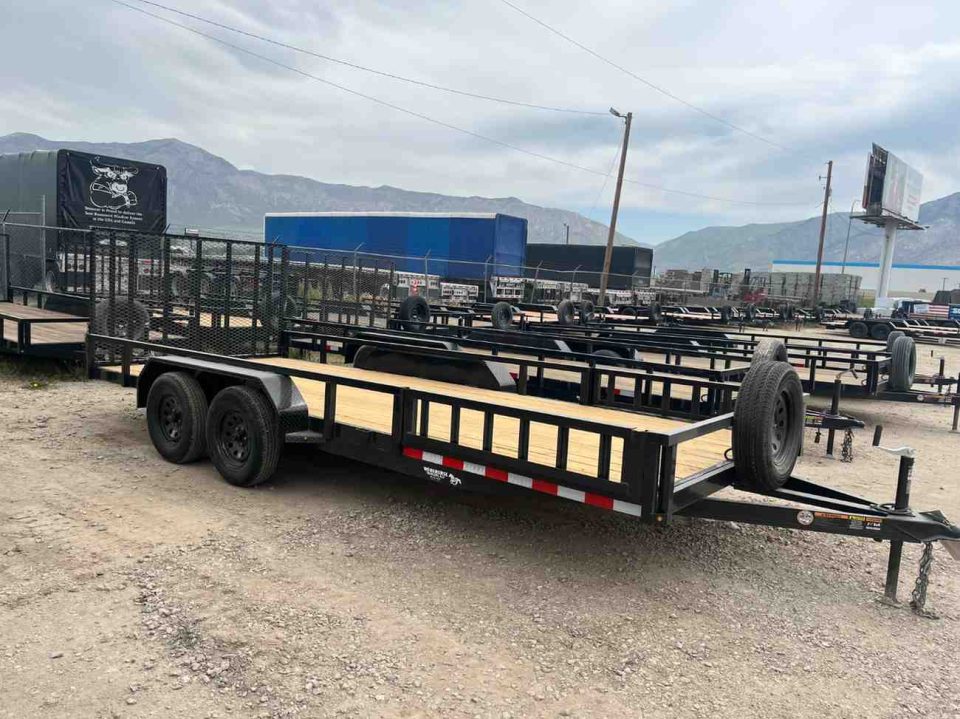
Most people walk onto a trailer lot thinking they need to pick from what’s sitting there. That’s not how it works at Workhorse Trailers. Roughly a third of the trailers rolling out of the Northern Utah shop are custom builds, engineered around a specific job that no off-the-shelf trailer handles well. Some of those builds are straightforward. Others are the kind of project that takes three design meetings, a pile of sketches, and a conversation with the customer’s insurance agent before the first piece of steel gets cut.
What follows are five real build scenarios that show what’s actually possible when you stop trying to force a stock trailer into a job it wasn’t made for. The details have been generalized to respect customer privacy, but the design decisions and takeaways are the same ones that come up repeatedly at the shop.
1. The Mobile Solar Panel Trailer for a Remote Jobsite
A construction crew running utilities in a canyon west of Tooele needed power for tools, a small office trailer, and overnight battery charging. Running a generator 24/7 was burning through fuel and costing more than the job could absorb.
The build: a 20-foot deckover trailer fitted with a rack system for eight bifacial solar panels, a weatherproof cabinet for the inverter and battery bank, and integrated grounding for field use. The deck was reinforced with extra cross-members to handle the dead weight of the batteries without flex.
The lesson here is about load distribution. Solar builds look light on paper, but lithium battery banks can add 800 to 1,200 lbs concentrated in a three-foot section. A standard utility trailer deck flexes under that kind of point load over time. Reinforcing during the build costs a few hundred dollars. Fixing it after the deck cracks costs a full rebuild.
2. The Landscape Trailer That Does Four Jobs
A landscaping company in Cache Valley was running three separate trailers: one for mowers, one for dump runs, and one for hauling their mini skid steer between sites. Three trailers meant three registrations, three sets of tires to maintain, and a yard full of equipment that was never where they needed it.
The solution was a single 7×16 tandem-axle trailer with removable side gates, a hydraulic dump section in the front third, a reinforced rear ramp gate rated for the skid steer, and mounted racks for trimmers, blowers, and fuel cans along the tongue.
The build replaced all three trailers. The crew reported saving roughly 40 minutes a day in loading and staging time, which over a season is real money. Multi-use landscape trailers are one of the most requested custom builds at Workhorse Trailers, and the pattern is almost always the same: consolidate, modularize, and design around the actual workflow rather than generic specs.
3. The Classic Car Enclosed Trailer with a Hidden Workshop
A collector in Davis County wanted to haul a 1967 Camaro to shows around the Mountain West without scratching the paint or exposing it to weather. Stock enclosed cargo trailers work for transport, but this customer also wanted to detail and make minor adjustments at the show without unloading.
The build: a 24-foot enclosed trailer with interior wall cabinets, a fold-down workbench, 30-amp shore power hookup, LED interior lighting on a separate circuit, and a polished aluminum diamond plate floor with recessed D-rings. The front wall included a narrow storage compartment for a generator and detailing supplies, accessible without opening the rear ramp.
The takeaway applies to anyone hauling something valuable. Enclosed trailers are often sold as empty boxes, but the interior is where the real value gets built. Planning the interior layout before the shell is framed saves significant retrofit cost later. Adding tie-downs, shelving, and electrical during the build is a fraction of the cost of adding them afterward.
4. The Beekeeper’s Gooseneck with Stacked Hive Racks
A commercial beekeeper moves hives seasonally across Utah and Idaho for pollination contracts. Loading and unloading hundreds of hives by hand is brutal work, and stacking them on a flat deck creates balance issues during transport.
The custom gooseneck was 28 feet long with integrated racking that let hives be forklifted on and off in stacked units. The rails included tie-down points at four heights, ventilation gaps sized for standard Langstroth boxes, and a lower deck height than a standard gooseneck to reduce ramp angle during loading.
This is a specialty build, but the principle is universal. If you load and unload the same cargo repeatedly, designing the trailer around that specific process pays back fast. The Utah Department of Agriculture has guidelines on transporting livestock and bees that also shaped the build, particularly around ventilation and tie-down requirements.
5. The Contractor’s Tool and Material Combo Trailer
A framing contractor wanted one trailer that could haul lumber to the jobsite in the morning and secure tools overnight. Open trailers lose tools to theft. Enclosed trailers don’t handle 20-foot lumber well.
The hybrid build was a 20-foot trailer with a 12-foot enclosed front section for tools, a locking rear bulkhead, and an 8-foot open flatbed rear with removable stake sides. Lumber slid alongside the enclosed section or rode on a roof rack that extended the full length of the trailer. Interior tool storage included a locking cabinet for higher-value items and a workbench.
Cost was roughly 30% more than a comparable enclosed cargo trailer, but it replaced two separate trailers and gave the contractor a secure overnight setup at remote jobsites. Hybrid designs like this come up often for contractors, electricians, and plumbers who need both open hauling capacity and locked storage.
What These Builds Have in Common
Every custom trailer built in the Workhorse Trailers shop starts with the same question: what does your day actually look like when you use this trailer? Not the spec sheet, not the dream scenario, but the real daily workflow. The best builds come out of long conversations where the customer describes the job step by step and the build team asks where the pain points are.
Custom doesn’t always mean expensive. Many builds are stock trailers with targeted modifications that cost a few hundred dollars and solve a problem that would have aggravated the owner for years. Other builds are full ground-up engineering projects. Both are worth the conversation.
If you’ve got a job that a stock trailer doesn’t quite fit, bring a photo of what you haul, a rough sketch of what you wish you had, and a list of what isn’t working with your current setup. The team at Workhorse Trailers can usually tell within a short conversation whether a stock trailer with modifications will do the job or whether a full custom build makes more sense. Either way, the answer starts with your actual work, not a showroom.
