
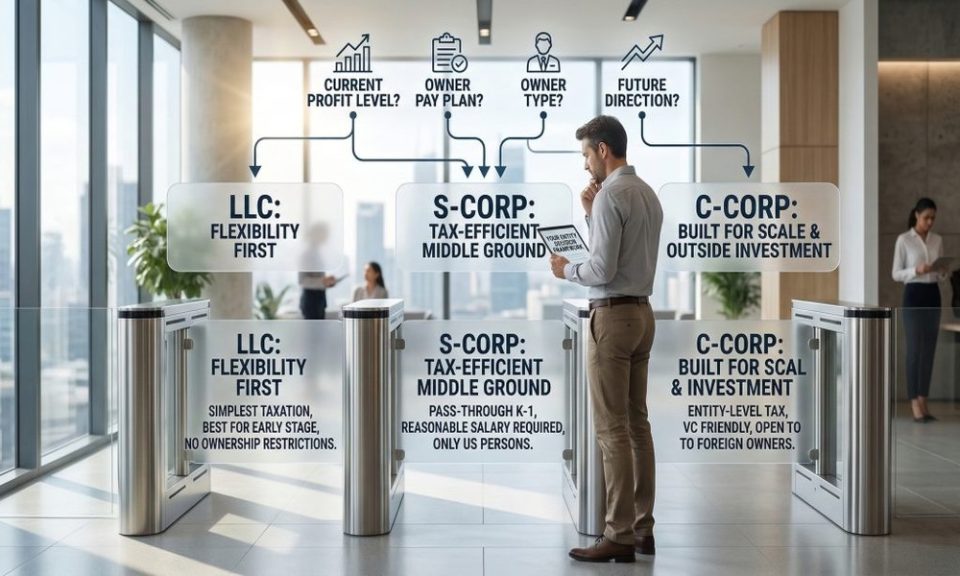
The entity choice question in Texas looks simpler than in most states because Texas has no state income tax. The reality is more layered. Texas businesses still pay the Franchise Tax (often called the margin tax) at the entity level, the federal tax overlay still drives most of the decision, and the Texas Business Organizations Code adds entity options like the series LLC that do not exist in many other jurisdictions. A Dallas startup, a North Texas consulting firm, and a family business in Frisco can each end up with different correct answers based on the same revenue figures. Working with a Dallas business law attorney before filing the Certificate of Formation with the Secretary of State is consistently cheaper than restructuring later, and the differences between options are larger than most founders assume.
Here is what actually separates the three structures in Texas, with the numbers and statutes that drive the decision.
The LLC: The Default for Most Texas Small Businesses
Texas limited liability companies are governed by Title 3, Chapter 101 of the Business Organizations Code. Formation requires filing a Certificate of Formation with the Texas Secretary of State for $300, designating a registered agent, and adopting a written company agreement. Texas does not require the company agreement to be filed with the state, but it controls the relationships among members, allocation of profits and losses, capital contributions, and exit procedures.
Federal tax classification is where LLCs earn their flexibility. A single-member LLC is disregarded for federal tax purposes by default, and a multi-member LLC files as a partnership. Texas does not impose an entity-level income tax on either, but every Texas LLC files a Franchise Tax report with the Comptroller of Public Accounts annually by May 15.
Two specific Texas LLC features deserve attention.
The series LLC, available under BOC §§ 101.601 through 101.622, allows a single LLC to establish multiple internal “series,” each with its own members, assets, and liabilities. Liabilities of one series do not reach the assets of another, provided the formation documents and recordkeeping are properly maintained. Real estate investors holding multiple properties, holding companies with several operating divisions, and businesses with distinct product lines all use series LLCs to compartmentalize liability without filing multiple separate entities. A single Franchise Tax report covers the entire series structure.
The professional LLC (PLLC), governed by BOC Title 7, is required for licensed professionals practicing in Texas (physicians, attorneys, architects, engineers, accountants, and similar). All members must hold the same professional license. Standard LLCs cannot be used to provide services that require state licensure.
The S-Corp: A Tax Election With Texas-Specific Implications
The federal S-Corp election (Form 2553) reclassifies an underlying corporation or LLC for federal tax purposes. Owner-employees pay themselves a reasonable salary subject to FICA, with additional profits flowing through as distributions that escape self-employment tax. For a Dallas consulting firm earning $250,000 in net income, the federal SE tax savings can exceed $10,000 annually.
Texas adds several specific considerations.
The federal S-Corp election does not change Texas Franchise Tax treatment. Both S-Corps and C-Corps pay the Franchise Tax at the entity level if their annualized total revenue exceeds the no-tax-due threshold ($2.65 million for 2026 reports). The Franchise Tax rate is 0.75 percent of taxable margin for most entities, 0.375 percent for retail and wholesale taxpayers, and 0.331 percent under the EZ Computation method available for entities with $20 million or less in annualized total revenue.
A Dallas business with $300,000 in net income and $1.2 million in revenue still owes no Franchise Tax (below the threshold) regardless of S-Corp election, but the same business at $4 million in revenue would owe Franchise Tax on its taxable margin. The S-Corp federal election produces SE tax savings without affecting that state-level liability.
The “reasonable salary” requirement is the trap that catches many Texas S-Corp owners. The IRS expects active owner-employees to pay themselves market wages before taking distributions, and aggressive distributions paired with low salaries invite reclassification audits. Texas courts and the Texas Workforce Commission also look at compensation structures when evaluating wage and unemployment insurance issues.
The C-Corp: Built for Capital, Heavier on Tax
C-Corporations pay federal corporate tax at 21 percent and the Texas Franchise Tax on their margin. Shareholders pay personal federal income tax on dividends, producing the classic double-taxation that rules C-Corps out for most small businesses.
Three specific reasons keep C-Corps on the table for certain Dallas founders.
Outside investment. Venture capital funds, most institutional investors, and many sophisticated angel investors require a C-Corp, almost always Delaware-domiciled with Texas operations. Convertible notes, SAFEs, and preferred stock arrangements do not work cleanly with LLCs.
Section 1202 Qualified Small Business Stock. Under federal law, founders and early investors in a C-Corp can exclude up to $10 million in capital gains on a sale of qualifying stock, provided the holding period and other requirements are met. The benefit is significant enough that many growth-oriented Dallas tech founders form as C-Corps despite the double tax.
Employee equity. Granting incentive stock options and building a meaningful employee equity program is materially cleaner in a C-Corp than in an LLC.
For Texas-based C-Corps, formation is similar to LLCs (Certificate of Formation, $300 filing fee, registered agent), but ongoing corporate governance under BOC Title 2 requires bylaws, board minutes, and shareholder records that LLCs are not required to maintain.
A Practical Decision Framework
Three questions usually drive the answer for a Dallas business in 2026.
Will the business raise institutional capital? If yes, plan for a Delaware C-Corp from formation. The cost of converting an LLC to a C-Corp later is real and includes federal tax friction.
Will the business consistently generate profits well above what the owner would pay themselves as a salary? If yes, an LLC with an S-Corp election deserves analysis. The SE tax savings can justify the additional administrative complexity.
Is the business a single-owner service business with modest revenue and no investor plans? A standard Texas LLC, properly documented, is usually the right answer.
Other questions sharpen the analysis. Will the business hold real estate or multiple distinct operations? A series LLC may be the right structure. Are the owners licensed professionals? A PLLC is required regardless of preference. Will the entity stay below the Franchise Tax no-tax-due threshold? The state-level tax burden may be zero either way, which simplifies the federal-tax-driven decision.
When to Bring in a Dallas Business Law Attorney
Entity selection in Texas is a tax question, a liability question, and a fundraising question, and the Texas-specific layers (margin tax, series LLCs, PLLCs for licensed professionals, the BOC’s specific governance rules) change the analysis in ways that generic online formation services almost always miss. A Dallas business law attorney working alongside a CPA can run the actual numbers for the specific business and structure the formation, the company agreement or bylaws, and any related federal tax elections in a coordinated way.
The Mundaca Law Firm advises Dallas founders on entity selection, formation documents, and the operating agreements and shareholder arrangements that fit each structure. If you are forming a new business, restructuring an existing one, or wondering whether your current entity still fits where the company is going, a conversation before the next filing deadline is the right time to have it.